

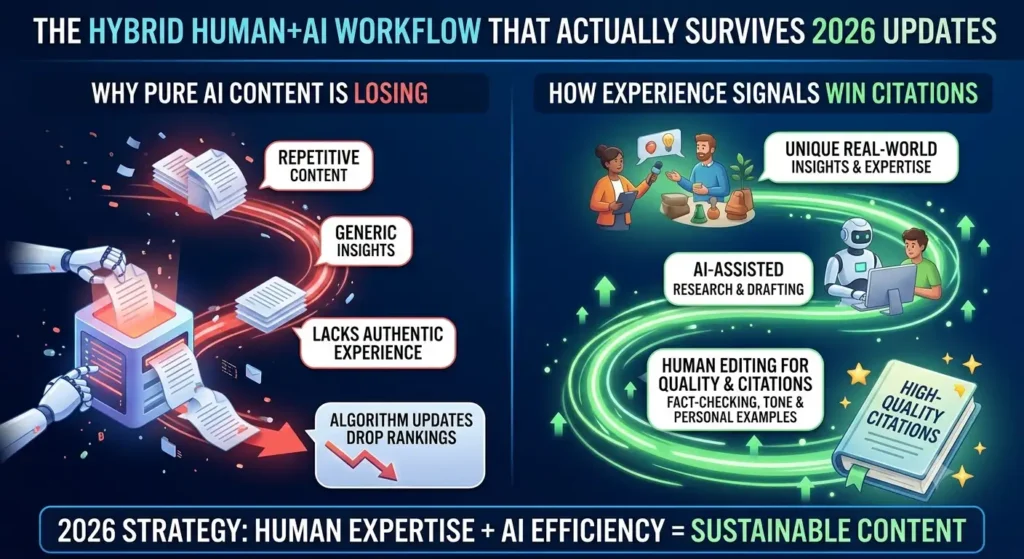
Pure AI content is everywhere right now. It’s fast, cheap, and scalable. Yet a growing number of those pages are quietly losing rankings and, more importantly, getting ignored by AI Overviews and chatbots.
The data from 2026 is pretty clear: pages with heavy or unedited AI content rarely hold the top spots and get cited less often. Human-directed content—especially content that shows real experience—still dominates Position #1 and earns more trust from the models that generate answers.
The winners aren’t the ones avoiding AI. They’re the ones using it as a tool inside a deliberate hybrid workflow that prioritizes experience signals.
Why Pure AI Content Is Struggling
Google doesn’t ban AI. Its public stance remains that quality and helpfulness matter more than how the content was produced. The problem is that pure AI output often fails the quality test in practice.
It tends to lack first-hand details, specific observations, and original insights. Models can generate polished text, but they can’t invent genuine experience. When AI Overviews and tools like ChatGPT decide what to cite, they favor sources that demonstrate real knowledge—exactly the kind of signal pure AI struggles to create.
Recent analyses show human or heavily edited content is far more likely to hold the number one ranking. AI-assisted pages appear across the top results, but the purely generated ones drop off quickly. Trust in AI answers has also declined, which makes authentic human signals even more valuable.
The Hybrid Workflow That Works in 2026
The effective approach is straightforward: let AI handle the heavy lifting on structure and first drafts, then layer in human experience, original data, and careful editing. Here’s a practical version of the process that holds up under current updates.
1. Start with real research and experience, not a prompt Before opening any AI tool, gather what only a human can provide: personal observations, client results, experiments you’ve run, or conversations with people in the field. This becomes the foundation the AI will expand on.
2. Use AI for the scaffolding Feed the tool your notes, key points, and target questions. Ask it to create an outline, expand sections, or generate a first draft. Treat the output as raw material, not finished work.
3. Inject experience signals This is the step most teams skip. Go through the draft and add:
- Specific examples from real work
- Numbers or results you’ve actually seen
- Observations that only someone who has done the work would notice
- Clear attribution for any claims
These details turn generic text into something models can treat as credible.
4. Structure for both humans and machines Make the content easy to extract. Use clear question-style headings where natural, put direct answers near the top of sections, and keep paragraphs focused. This helps with both traditional rankings and citation in AI answers. For more on formatting that works well with large language models, see our guide on LLM-friendly content frameworks.
5. Fact-check, edit for voice, and add proof Remove anything that sounds templated. Tighten the language so it matches how you (or your brand) actually speak. Add sources, author context, and any supporting evidence. A strong E-E-A-T audit at this stage catches gaps before publishing.
6. Publish, then watch the signals After the page goes live, monitor both classic rankings and whether it starts appearing in AI-generated answers. Update it when you gain new experience or data.
Why Experience Signals Win Citations
AI systems are under pressure to reduce hallucinations and low-quality answers. They respond by favoring sources that look trustworthy. Experience is one of the strongest filters they use.
When a page includes concrete details—what happened when a strategy was tested, what customers actually said, or how a process worked in a specific situation—it becomes harder for the model to dismiss. Generic advice is easy to generate. Lived detail is not.
This is also why author information, clear credentials, and consistent topical depth continue to matter. Models notice patterns of expertise across a site. One strong page helps, but a body of experience-backed content builds lasting authority.
Common Mistakes to Avoid
- Publishing AI drafts with only light proofreading
- Relying on FAQ sections that any model could invent
- Hiding the human role or pretending the content is purely original when it isn’t
- Ignoring original data or first-hand examples because they take more time
The goal isn’t to eliminate AI. It’s to make sure the final product carries signals that pure generation can’t fake.
What This Looks Like in Practice
A typical hybrid page might start with an AI-generated structure based on your research notes. You then rewrite the introduction with a real example from recent work, add a short case observation in the middle, update statistics with your own tracking data, and close with practical caveats only experience would reveal. The result reads naturally, ranks more reliably, and stands a better chance of being cited when someone asks an AI for advice.
Teams that treat AI as a junior assistant rather than a full replacement are the ones still growing visibility in 2026. The ones flooding the web with unedited output are the ones watching traffic and citations slip.
If you want to check how your current content stacks up on trust signals, the full E-E-A-T audit checklist is a useful starting point. Pair it with the LLM-friendly frameworks and you’ll have a solid system for producing content that both ranks and gets cited.
The hybrid approach takes more effort than pure automation. It also produces work that lasts.
