

Most people still optimize content for the original search query. That approach is quickly becoming incomplete.
When someone types a question into Google, ChatGPT, Perplexity, or Gemini, the system rarely treats it as a single question. It expands the query into a cluster of related micro-questions—what researchers and practitioners now call query fan-out. The pages that answer those micro-questions clearly and completely are the ones getting cited in AI Overviews and pulled into chatbot responses.
What Query Fan-Out Actually Is
Query fan-out is the process large language models use to break a user’s request into smaller, related sub-questions so they can gather enough information to produce a solid answer.
A user might ask: “Best project management tools for remote teams in 2026”
The model doesn’t just look for pages ranking for that exact phrase. It fans the query out into questions like:
- What features matter most for remote collaboration?
- How do pricing models compare for small vs. mid-size teams?
- Which tools integrate well with Slack and Google Workspace?
- What are common complaints from actual remote teams?
- Are there free or low-cost options that still work at scale?
The AI then pulls passages from multiple sources that address these sub-questions and synthesizes them. Your page gets cited when it supplies one or more of those clear, self-contained answers.
This is why traditional top-10 rankings no longer guarantee AI visibility. Studies in 2026 show the overlap between classic Google rankings and AI Overview citations has dropped noticeably. A page can rank well and still be ignored by the model if it doesn’t cover the fan-out.
Why This Matters More in 2026
AI Overviews now appear on a large share of informational queries. ChatGPT and similar tools handle billions of prompts daily. Zero-click behavior keeps rising because users often get what they need inside the AI interface.
Brands that treat content as a collection of extractable answers—not just long-form articles—are pulling ahead on citations. The ones still writing broad, keyword-focused pieces are losing share of voice inside the answers people actually see.
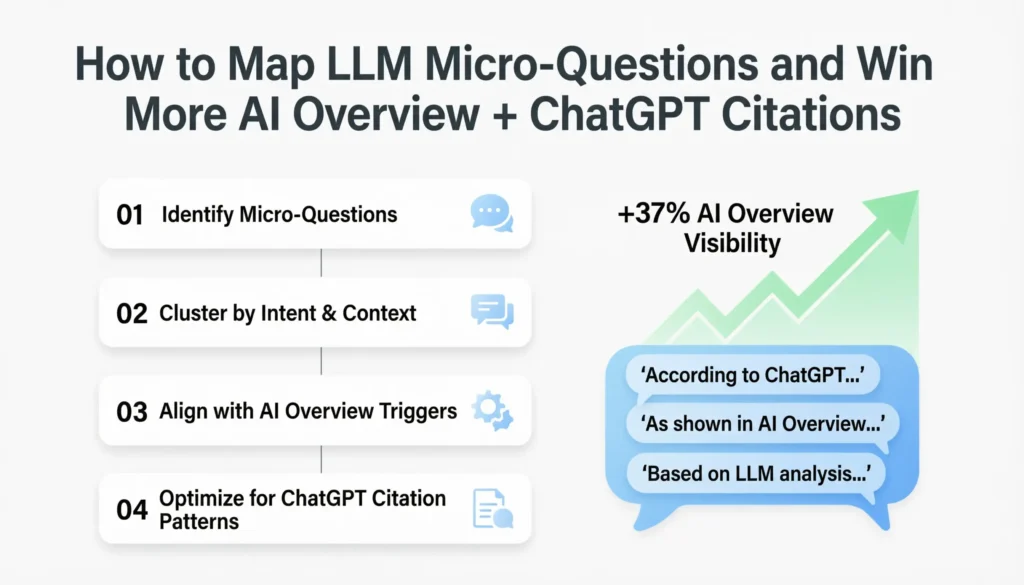
How to Map LLM Micro-Questions (Practical Process)
You don’t need special tools to start, though some help. Here’s a repeatable method.
1. Start with your core query and generate the fan-out yourself Take your primary target question and ask ChatGPT, Claude, Perplexity, or Gemini: “What related questions would you need to answer fully before responding to [your query]?”
Run the same prompt across a few models. You’ll quickly see overlapping micro-questions. Note the ones that appear consistently.
2. Study real user language Look at People Also Ask boxes, Reddit threads, Quora, and forum discussions around your topic. Real people phrase the micro-questions differently than marketers do. Capture the exact wording.
3. Use search console and analytics data Check which queries already bring traffic or impressions to your pages. Many of those are already partial fan-out questions. Expand from there.
4. Build a simple fan-out map For each main topic, create a short list:
- Primary query
- 6–12 micro-questions the model is likely to generate
- The specific answer or data point your content should provide for each
Keep the answers tight. AI systems prefer clear, self-contained passages they can lift without heavy rewriting.
5. Test and refine Once you publish or update a page, prompt the major AI tools with variations of your primary query and see whether your content appears in the response or citations. Adjust the sections that get ignored.
Turning the Map into Content That Gets Cited
Mapping is only half the work. The content itself has to be easy for models to extract and trust.
Write answer-first sections. Put the direct response in the first one or two sentences under each heading. Models often pull from the opening of a clear section.
Use question-style headings where it feels natural. An H2 that matches a micro-question increases the chance the passage gets selected.
Add original or specific data. Generic advice is easy for models to generate themselves. Unique statistics, first-hand observations, or clearly sourced numbers give them a reason to cite you.
Keep entities and relationships clear. Mention specific tools, concepts, or brands in context so the model can connect the dots.
Structure for extraction: short paragraphs, bullet lists, and simple tables help. Dense walls of text are harder for models to parse cleanly.
Strengthen the surrounding E-E-A-T signals. Author experience, clear sourcing, and consistent topical authority still influence which sources models prefer.
Measuring Whether It’s Working
Track more than rankings. Look at:
- How often your pages appear in AI Overview citations for target queries
- Mentions or links inside ChatGPT, Perplexity, and Gemini responses
- Changes in branded search and direct traffic that may come from AI referrals
- Share of voice against competitors on a fixed set of prompts
Some teams run weekly prompt sets and log citation frequency. Even a simple spreadsheet works when you’re starting out.
A Realistic Expectation
Query fan-out optimization won’t turn every page into an overnight citation machine. It works best on informational and commercial-investigation content where users ask layered questions. Product pages and pure transactional content often need different tactics.
The biggest gains usually come from updating existing solid pages rather than creating dozens of new ones. Take your best-performing content, map the fan-out, and fill the gaps the models care about.
Final Thought
Search is no longer just about matching a keyword. It’s about supplying the pieces an AI needs to build a complete answer. The sites that systematically map those micro-questions and answer them cleanly are the ones showing up inside the responses people actually read.
Start with one important topic this week. Generate the fan-out, update the page, and test it across a few AI tools. You’ll see the difference faster than you might expect.
That’s the practical path to more AI Overview and ChatGPT visibility in 2026.
